Name the comparison that keeps returning
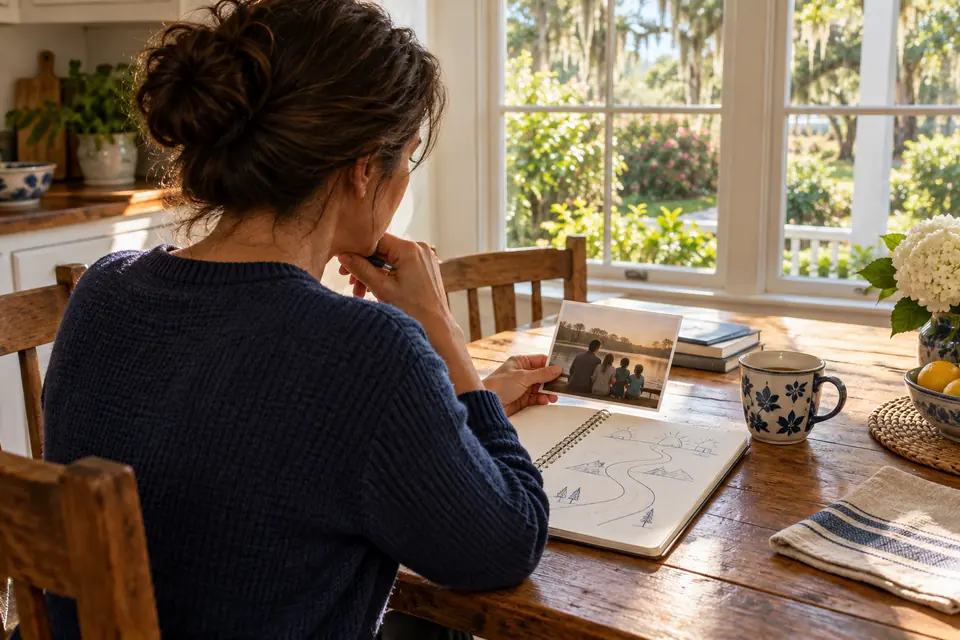
Choose one comparison you notice making repeatedly. Describe the actual claim: someone appears further ahead in a skill, has a more visible achievement or seems to maintain a routine more easily. Keep the description narrow. A specific comparison can be examined; a conclusion that everyone else has life figured out leaves almost nothing concrete to review.
Write what the comparison makes you want to change. You may be identifying a genuine goal, a missing skill or a desire for recognition. Those are different questions. The purpose here is not to prohibit noticing other people’s work. It is to turn a repeated comparison into a clearer inquiry about your own direction, using information you can observe responsibly instead of an imagined account of someone else’s whole life.
Separate visible results from unknown conditions
List what you actually know about the example and what you are assuming. A finished project may be visible while the preparation, assistance, available time and previous attempts are not. A public milestone gives some information, but it does not supply a complete baseline for your circumstances. Mark unknown conditions as unknown rather than filling them with a convenient explanation.
Avoid turning this step into speculation about why another person succeeded. You do not need to diminish their work to choose a more useful measure for yours. Return to the question their example raised. If a particular skill interests you, you can identify a learning opportunity without deciding whether your entire life is ahead of or behind theirs. The comparison becomes more useful when it points toward a concrete question rather than a verdict.
Choose the purpose before choosing a score
State what you want your own activity to accomplish. For reading, the purpose might be understanding an argument well enough to discuss it. For a household routine, it might be making a needed item reliably available. A measure should help you assess that purpose. Counting activity is not automatically the same as assessing whether the activity did its job.
Use one sentence that describes the desired change in ordinary terms. If the sentence contains several unrelated goals, choose the one this review will address. You can maintain other priorities without measuring all of them together. The personal-definition guide helps when the underlying purpose is still unclear. A better score cannot rescue a measure attached to a goal you have not actually chosen.
Establish a baseline you can explain
Describe your current starting point using the same type of observation you plan to make later. If you are learning a practical skill, attempt an appropriate beginner task and record what you can do independently and where you need guidance. If you are improving an arrangement, note how the arrangement currently functions during an ordinary opportunity.
Keep the baseline descriptive and proportionate. It is a reference for learning, not a permanent identity. Do not manufacture a particularly poor starting point to make later improvement look impressive, or a particularly good one to protect your pride. Note relevant conditions such as access to materials or help. A modest baseline that someone can understand is more useful than a precise-looking number whose meaning changes whenever the result feels uncomfortable.
Use observations that match the activity
Choose a small combination of activity and output evidence. Practice time may help explain an attempt, while a completed task or clearer explanation may show what the attempt produced. Neither observation tells the whole story by itself. Decide which question each one answers before adding it to a record.
For example, counting pages read may describe volume without showing understanding. A short explanation in your own words can reveal a different aspect of the work. That does not mean every reading session needs an examination. Choose an observation light enough to maintain and relevant enough to inform the next choice. If recording the measure requires more effort than the activity it is supposed to support, simplify the record before adding another tracking tool.
Keep circumstances beside the result
A result changes meaning when the conditions change. An independent attempt differs from one completed with guidance. A short uninterrupted session differs from a session shaped by a necessary care responsibility. Note the condition that materially affects interpretation, without turning every record into a detailed defense of the day.
Context is not a device for refusing all feedback. It helps you decide what the feedback can fairly support. You may still need to change an approach, ask for help or honor an agreement after a difficult attempt. Keep both facts visible: the conditions mattered, and the next responsibility still needs a decision. This makes a personal measure more useful than a ranking that ignores the circumstances in which the result was produced.
Try a fictional practical-learning example
Imagine a reader learning to repair a small item of clothing. The reader keeps comparing early attempts with polished work shown online. Instead, the reader chooses a simple repair appropriate to their current skill, records where guidance is needed and practices the same type of task again. The baseline is the reader’s own understandable starting point.
The record distinguishes a repair made with step-by-step assistance from one completed independently. A faster attempt with a weak result is not automatically better than a slower, sound attempt. The reader asks a knowledgeable person for feedback where appropriate and avoids treating a personal measure as professional qualification. The useful comparison is between relevant attempts under described conditions, with attention to what the reader can now do and what still needs instruction.
Notice when a measure rewards the wrong thing
Review how the measure influences your choices. A count of completed tasks may encourage selecting easy tasks while avoiding the important one. A public streak may encourage reporting activity that did not serve the purpose. If the measure begins steering the activity away from its intended job, revise the measure rather than defending the score.
Write one way the measure could be misleading and one observation that would help reveal that problem. You do not need a perfect system resistant to every possible distortion. You need enough honesty to notice when the record has become a performance for the record itself. Keep the underlying purpose available so a convenient number does not quietly replace the reason you started tracking.
Review patterns without rewriting the starting point
At a chosen review occasion, compare the current observation with the recorded baseline. Keep the original baseline intact. If your understanding of the activity has changed, explain the change and create a new reference alongside it rather than rewriting the earlier record to produce a preferred story.
Ask what the evidence supports, what remains uncertain and which next action follows. You may have improved one part while another remains difficult. You may also discover that the chosen observation was not informative enough. Those findings can guide a better attempt. The progress-evidence guide addresses milestones within an unfinished goal; this exercise stays focused on replacing an unsuitable external comparison with relevant personal observations.
Keep the record useful and appropriately private
Choose where the record will live and who needs to see it. A private notebook may be enough. If another person is helping, share the relevant attempt and question without exposing unrelated personal information. A learning group can practice selecting measures with fictional examples rather than displaying participants’ actual records or ranking their progress.
Finish by writing the purpose, baseline, chosen observations and review occasion on one short page. Add a reminder about what the measure does not establish. Your record can support a next step without proving your worth, predicting an outcome or qualifying you to advise others. Use the Life collection for related exercises, or ask about a group learning conversation with a clear educational scope.
Build your private practice page
Build a sample record with three columns: observation, conditions and next question. Use an ordinary learning activity such as explaining a chapter to a friend who has agreed to listen. In the observation column, record whether you could describe the main idea and give an appropriate example. In conditions, note whether you used your notes or received prompts. In next question, identify the part you still did not understand. This record describes a particular attempt. It does not establish that you understood every claim in the chapter or that another person’s quicker explanation provides a fair ranking of your ability.
Before the next attempt, choose which condition should stay similar for the comparison to be informative. You might use a passage of comparable difficulty or allow the same kind of notes. Where conditions change, record the change rather than treating every result as directly interchangeable. Do not seek artificial precision in a simple exercise. The purpose is to understand whether an approach helps and what deserves attention next. A rough observation with an honest description may tell you more than a numerical score built from changing rules you cannot explain.
When a comparison with someone else returns, use the record to ask a narrower question. You might want to learn how they organize an explanation rather than conclude that their whole learning path is superior. Ask appropriately if their method is something they are willing to describe. Then decide whether a limited version is worth trying in your own circumstances. Keep your earlier record intact so you can examine the effect of the change. The page should support curiosity and a responsible experiment, not become another instrument for proving a preferred story about yourself.