The next-chapter keynote
A practical talk about the life behind the numbers, everyday habits and taking one useful next step.
- Planning range: 30–45 minutes
- Optional audience questions
- For conferences, teams and community events
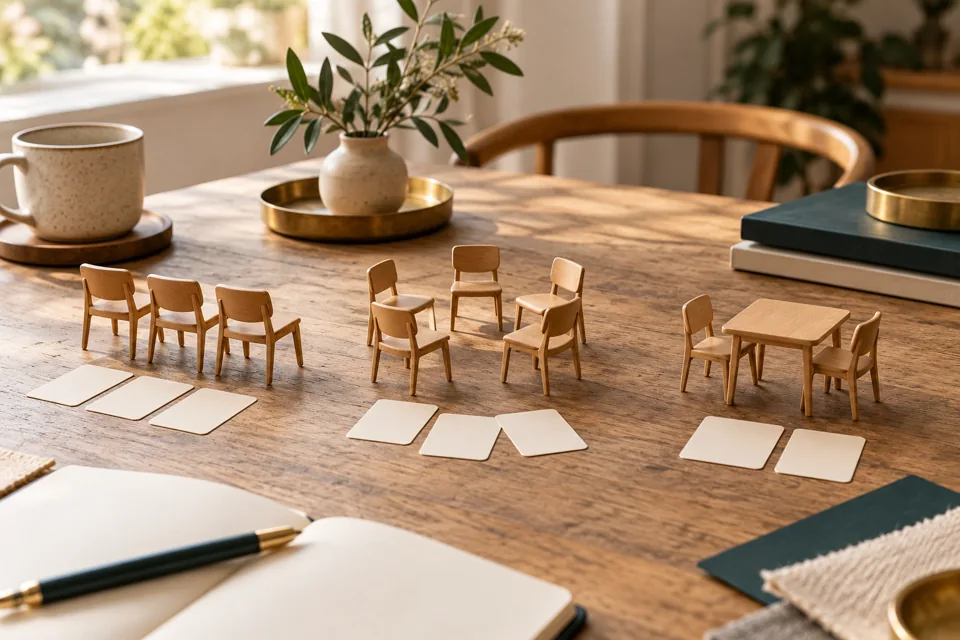
Use a decision worksheet to match a learning task to available time, participant access, room conditions and a workable practice cycle.
Planning an assembly, staff training or community night? Start with a few details and Eric will take it from there.
Who’s coming, roughly how many, date ideas and what you hope they take away.
Eric follows up to discuss fit, format and the details of your event.
A request starts the conversation. It doesn’t confirm a booking or a fee.
Schools, teams and community groups. Bring Eric’s practical money and life conversation to the people you want to encourage.
Promotional slideshow with illustrative scenes. The song is performed by a separate singer, not Eric.
Download the vertical video ↓Give your people a reason to move.
From the classroom floor to the working crew,
Everybody needs a next step they can use.
Talk about money, talk about life,
Turn a good intention into something you write.
Bring Eric in, get the whole room thinking,
Less drifting, more doing, start building.
Book Eric to speak, make the next move count.
Put a plan in their hands, turn the volume up loud.
Schools, teams, communities too,
A practical conversation made for your crew.
Bring Eric in, let the next chapter begin!
Hire Eric to speak.
Tell him about your event.
Three ways to begin planning. Eric confirms the topic, length, delivery and fit for your audience.
A practical talk about the life behind the numbers, everyday habits and taking one useful next step.
Examples, reflection and selected exercises that help participants connect a lesson to their own questions.
A facilitated conversation around selected themes from The Life Manual, with room to reflect and ask questions.
Eric’s bio, format ideas, a planning brief and a practical room checklist—in one event-planner kit.
The word workshop can describe many experiences. A room may listen to a talk, work through an example, discuss a reading or alternate among several activities. Begin by writing the task participants should complete and the constraints that cannot move. This guide helps you make that operational choice. The speaking-format pages provide broader comparisons of delivery arrangements; use them for orientation, then return here to test a particular plan against the people, time and setting you actually have.
Draw four columns on a working sheet: learning task, participation needed, available conditions and unresolved questions. Fill them with concrete statements. “Compare two fictional options” is a task. “Read and discuss in pairs” is participation. “Fixed seats and forty minutes” is a condition. “Can participants hear each other?” is a question. Keeping these categories separate makes it easier to identify a format that fits without assuming that the most elaborate option is the most useful.
A complete practice cycle includes an explanation, an attempt, a way to inspect the reasoning and a closing connection. If the group only hears instructions, it has not yet tried the method. If people complete a page but never understand why a step matters, the activity can feel mechanical. Choose a modest task that can travel through the entire cycle. An invented household example may allow learners to sort expenses, explain a choice and identify what information remains unknown.
Write the cycle in participant language: first I notice, then I try, then I compare, then I decide what to review privately. Test whether each part is necessary and whether the order makes sense. Avoid adding several unrelated exercises because the room has tables. A complete short cycle gives the organizer a clearer basis for evaluating the format than a long agenda of activities that never reach discussion or reflection.
Set aside minutes for instructions, reading, thinking, participation and questions. Include the ordinary friction of opening a handout, moving a chair, joining a remote room or returning attention to the facilitator. For example, a fictional thirty-minute practice window might allow five minutes for explanation, eight for an attempt, eight for discussion, four for clarification and five for a closing choice. These are planning assumptions, not a universal formula; test them with the actual material and audience.
If the cycle does not fit, change one of the conditions deliberately. Reduce the task, shorten the example, choose a different participation method or ask whether a longer session is possible. Do not preserve an oversized agenda by deleting thinking time. A learner who needs a moment to read should not have to choose between understanding the example and keeping up with the next instruction. Mark an optional extension so the facilitator has a sensible choice when the group moves faster or slower than expected.
Individual reflection suits questions learners should consider privately. Paired discussion can help people explain a method without performing before the whole room. A full-group conversation can reveal different interpretations, but it needs moderation and enough time for more than the quickest voices. A demonstration can establish a shared example before practice. The decision is about what each method contributes to the task, not whether a format sounds lively in an invitation.
Consider the burden each method creates. Pairing can be uncomfortable when it requires personal disclosure. Small groups may be difficult in a noisy room. Public questions can favor people comfortable speaking without preparation. Offer alternatives where possible, such as written general questions or time to think before anyone responds. Use invented examples for shared work. An organizer should be able to explain why the chosen interaction helps learning and what a participant may do if that interaction does not work for them.
Inspect the physical or digital space against the proposed cycle. A writing exercise needs a usable surface. A comparison activity needs examples that can be read from the relevant seats or supplied in another usable form. A remote discussion needs clear joining instructions and a way to rejoin if a connection drops. Describe the conditions accurately on the decision sheet rather than assuming that a room reservation or meeting link guarantees a suitable learning environment.
Prepare a fallback that preserves the central task. If breakout rooms fail, can the group compare two general responses in the main room? If projection fails, can a readable handout carry the example? If a participant cannot use a personal device, is there another way to take part? Test the fallback before relying on it. A simpler format with a credible alternative may be more dependable than a complex plan whose essential step depends on untested equipment.
Imagine an organizer with twenty-four attendees, fixed classroom seating and a short midday window. The task is to identify missing information in a fictional spending decision. A roaming group exercise would require movement and extra explanation. A brief demonstration followed by private marking and moderated comparison may fit the conditions better. The choice follows from the task and setting; it does not prove that one delivery style is always superior.
Record why the selected approach fits and what would cause you to reconsider. If the group grows substantially, the question method may need to change. If more time becomes available, participants might try a second example. This conditional reasoning is more useful than assigning a false precision score to each format. You are making a practical judgment with incomplete information, so keep the assumptions visible and ask the facilitator to challenge them before the plan is final.
Send the decision sheet with a concise brief. Ask whether the task, timing, participation and material responsibilities form a workable whole. If Eric is being considered, describe the plan as a proposal and ask about availability and scope. A page comparing workshops does not establish a current offered program, an agreed engagement or a particular package. Confirm any books, supplementary resources, recording or follow-up separately rather than letting the format label imply those components.
Invite corrections early enough to make a change. The facilitator may suggest fewer examples, a different question channel or a more suitable way to use a chapter. Record the agreed version and explain meaningful changes to whoever handles invitations and logistics. Participants should receive a description that matches the actual experience. “General example and private practice” is a clearer promise than “complete financial transformation,” and it gives people a fair basis for deciding how to participate.
After the gathering, compare the planned cycle with what occurred. Did people have time to attempt the task? Could they inspect the reasoning? Which instruction needed repeating? Were there barriers related to seating, print, sound or the question method? Use a few observations and appropriate feedback rather than treating applause or attendance as proof of learning. Keep individual financial outcomes outside what this format review can establish.
Write one practical change for the next use of the decision sheet. You might simplify a handout, allow more reading time or offer questions in writing. Preserve the successful parts as well as the problems so the next organizer understands the reasoning. A format choice is complete when the team can explain what was selected, why it fit, which assumptions mattered and what the next iteration should test. That record is more reusable than a label alone.
Keep one sentence about the most plausible alternative and why it was not selected for this event. For example, a small-group discussion may have been attractive but unsuitable because the room lacks surfaces and the available window includes a meal. That note is useful when someone later asks why the plan is simpler than an earlier idea. It also reveals what would need to change for the alternative to become workable. Record the actual constraint rather than dismissing the format itself. A future event with different conditions may reasonably make a different choice.
Explore the organizer resource hub, compare the audience planning guide, or describe your format question to Eric. You can also ask about group book copies.
Choose reader lessons, group-book ideas or event-planning tips. Get five practical emails at a comfortable pace. You choose the path, and you can unsubscribe.
Staging preview: your selection is saved here; outside email delivery starts after launch.
Privacy information →Don’t see your question? Text Eric: 504-382-5584
It helps test one proposed workshop against actual tasks and constraints; the overview compares broader delivery possibilities.
Record the learning task, participation needed, available conditions and unresolved questions.
Include explanation, an attempt, inspection of the reasoning and a closing connection.
Write the task first so the format serves the intended learning rather than dictating it.
Include reading, movement, instructions and attention changes in the available time budget.
No. Consider privacy, comfort, sound and whether the interaction supports the task.
Yes, when the activity and question method fit the seating and available surfaces.
It preserves the central learning task through an alternative that has been prepared and tested.
A clear reasoned choice with visible assumptions is often more useful than an artificial score.
No. Send a proposal and confirm scope, availability and arrangements directly.
Describe the actual activity, preparation and privacy choices participants can expect.
Compare the planned cycle with actual participation, unclear instructions and practical barriers, then record a specific improvement.
Find practical guidance for briefs, materials, private participation and event review.
Explore resourcesAsk a few focused questions that improve the next event while separating learning, satisfaction, logistics and permission to publish.
Read the guideAsk Eric about group copies of The Life Manual.
Explore group booksStart with the pages. Then bring the conversation to the people who need it most.
Rather talk it through? Text Eric: 504-382-5584 · Call
